A 9B Vision-Language Model That Thinks Deeper by Reusing Its Own Layers
SenseNova-Loop-9B-Preview is SenseTime's looped-transformer vision-language model. Its middle layers run twice over shared weights, so it does the work of a ~14.6B model while storing only ~9B parameters. Give it a text prompt and up to two images and it answers in text. A preview release. Apache 2.0.
📸 See it in action
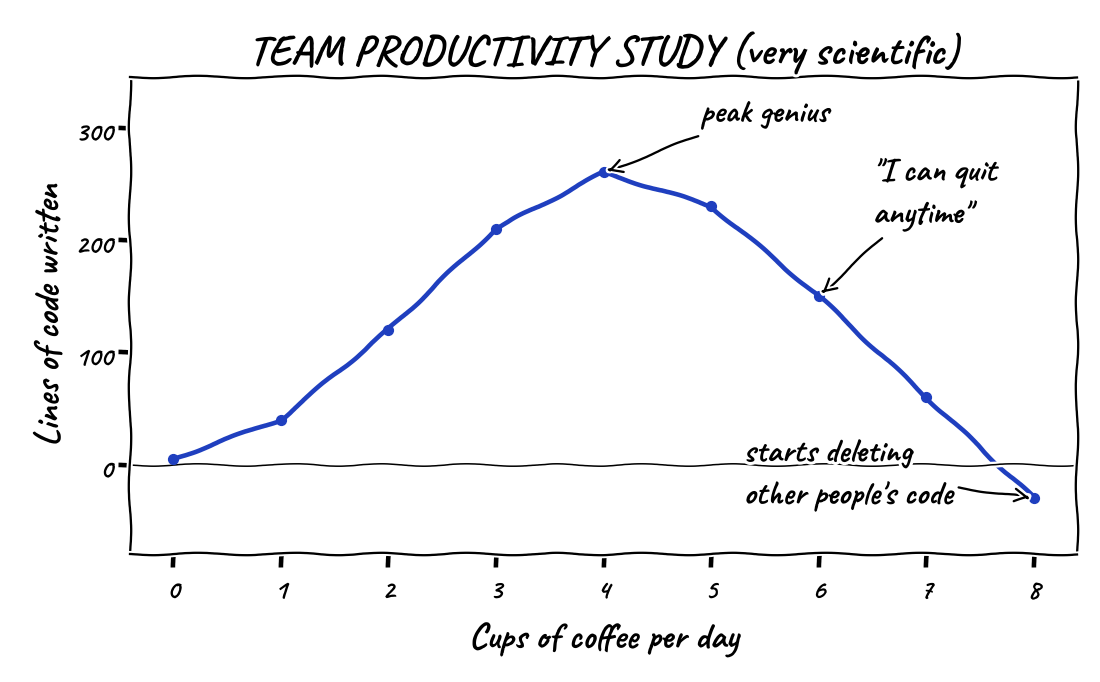
The very scientific coffee study. A hand-drawn chart from a team meeting, and three office tasks in one prompt: read the chart, write slide bullets, write SQL. Default settings, thinking off.
Prompt
This chart is from our team meeting. 1) Based on the chart, how many cups of coffee per day should each engineer drink? 2) Write three short bullet points for Monday's all-hands slide. 3) Write one SQL query that would produce this chart from a table coffee_log(employee, day, cups, lines_of_code).
SenseNova-Loop-9B-Preview's answer (unedited)
Here's a breakdown of the chart and answers to your questions:1) Recommended Coffee Intake
Based on the chart, each engineer should drink 4 cups of coffee per day — that's where the "peak genius" occurs at ~280 lines of code written.
- 0-3 cups: Productivity increases steadily
- 4 cups: Peak productivity (~280 lines)
- 5+ cups: Sharp decline in output
- 7-8 cups: Negative productivity (deleting other people's code)
2) Monday's All-Hands Slide
- 4 cups of coffee = peak productivity (280 lines of code/day)
- 5+ cups = diminishing returns — output drops 40%+
- 7+ cups = actively harmful — engineers start deleting other people's code
3) SQL Query
SELECT
    c.cups,
    SUM(l.lines_of_code) AS lines_of_code
FROM coffee_log c
JOIN (
    SELECT day, SUM(lines_of_code) AS lines_of_code
    FROM coffee_log
    GROUP BY day
) l ON c.day = l.day
GROUP BY c.cups
ORDER BY c.cups;
Wait — let me reconsider the table structure. Thecoffee_logtable has(employee, day, cups, lines_of_code), so each row is one employee on one day. The query should aggregate by cups:
SELECT
    cups,
    SUM(lines_of_code) AS lines_of_code
FROM coffee_log
GROUP BY cups
ORDER BY cups;
This groups all records by number of cups consumed and sums the lines of code written for each cup count, producing the curve shown in the chart.
What to notice: it got the joke and the peak (4 cups) right, but read the peak as ~280 lines when the chart shows about 260, and its first SQL draft was wrong — it caught that itself and rewrote it. For a per-engineer average, AVG would fit better than SUM. It's a preview model: check numbers it reads off a chart. The chart is a mock-up we drew for this example.
What it does
SenseNova-Loop-9B-Preview takes a text prompt and, optionally, one or two images, and returns a text answer.
What makes it different is the loop. Of its 32 decoder layers, layers 4–27 run twice with the same weights, giving 56 layer passes per token. Two residual streams are mixed by learned routers (mHC) inside the loop. The result: more compute per token — about 14.6B inference parameters — from a 9B-parameter model.
SenseTime aims it at agent and office work. Its benchmark set includes SQL (BIRD-Dev), terminal tasks (Terminal Bench 2.1), banking and automation workflows, and slide generation.
It is a preview: the technical report is still marked "TBD" on the model card. Treat results as early.
Problem it solves
Use case | How it helps |
Office and data tasks | Write SQL, summarize tables, draft slides from notes |
Agent planning | Break a task into steps or tool calls |
Image + text questions | Describe, compare or extract from one or two images |
Long inputs | Trained on sequences up to 262,144 tokens |
More depth at 9B | Looping adds reasoning depth without a bigger model |
Input/Output
Input
- Text (required) — the prompt or question
- Image 1 (optional) — a reference image
- Image 2 (optional) — a second image, to compare or reason over together
Parameters
Parameter | Details |
max_new_tokens | 1–8192, default 2048 (advanced). Cap on response length. Raise it for long answers or when thinking is on |
temperature | 0–2, default 0.0 (advanced). Greedy and deterministic. Above 0 turns on sampling |
top_p | 0–1, default 0.95 (advanced). Ignored at temperature 0 |
top_k | 1–100, default 64 (advanced). Ignored at temperature 0 |
enable_thinking | On / Off (default, advanced). On writes a reasoning block first — helps on multi-step questions; raise max_new_tokens with it |
Output
- Text — the generated response
Technical Details
Architecture | Looped transformer on a 32-layer multimodal decoder: layers 0–3 once, 4–27 twice (shared weights), 28–31 once — 56 layer passes |
Loop mixing | Two residual streams routed by learned mappings (mHC), Sinkhorn-normalized |
Attention | Hybrid — 3 linear-attention layers + 1 full-attention layer per group of 4 |
Parameters | ~9B stored, ~14.6B inference parameters |
Context | Trained on sequences up to 262,144 tokens |
Base | Qwen3.5-family decoder |
Released | October 30, 2026 (preview) |
Runtime | GPU, cloud — no local setup |
Compliance & Provenance
Provider | SenseTime (SenseNova) |
Provider type | Open-source |
License | Apache 2.0 |
EU AI Act risk class | Limited Risk |
Art. 50 transparency | Applicable — multimodal LLM output carries the AI-generated label |
Region availability | Available globally |
Training data summary | Pending — provider has not yet published per Art. 53(d) |
For more on how we classify models and mark outputs, see our AI Policy.
Model Source
- Model card
- GitHub: https://github.com/OpenSenseNova/SenseNova-Loop
- License: Apache 2.0
How SenseNova-Loop-9B-Preview compares
Model | Best for | Notes |
SenseNova-Loop-9B-Preview | Office and agent tasks at 9B, with extra depth | Looped; ~14.6B inference params; preview |
MiMo-V2.6-Distill-Qwen-9B | Code, tool use, software screenshots | 9B; MIT |
Agnes-3.0-Flash | Image + text with an adjustable reasoning dial | Preview checkpoint |
Qwen3.6-35B-MoE | Coding, agentic tasks, step-by-step reasoning | SWE-bench Verified 73.4% |
Qwen3.8-27B | Very long inputs with images | 262K context |
Gemma 4 31B | General reasoning default | MMLU Pro 85.2% |
Rough guidance: Gemma 4 31B or Qwen3.6 for production flows; try SenseNova-Loop when you want a 9B model with more reasoning depth and can accept preview-stage behavior. Scope notes come from each node's own documentation; the models have not been benchmarked against each other inside CNAPS Studio.
All of these run inside CNAPS Studio — compare them side-by-side.