Faithful 4× Video Upscaling to 4K — Keeps Faces, Text and Logos True to the Source
RelayVSR upscales a video exactly 4×, up to 3840×2160. It is a Precision upscaler: it stays close to what is in the source and invents little new detail, so faces, on-screen text and logos come out recognizably the same. Built by researchers at the University of Science and Technology of China. Apache 2.0.
📹 See it in action
DJ Whiskers, now in 4K. A 5-second, 960×540 clip of a cat headlining a club night, upscaled ×4 to 3840×2160. Default settings.
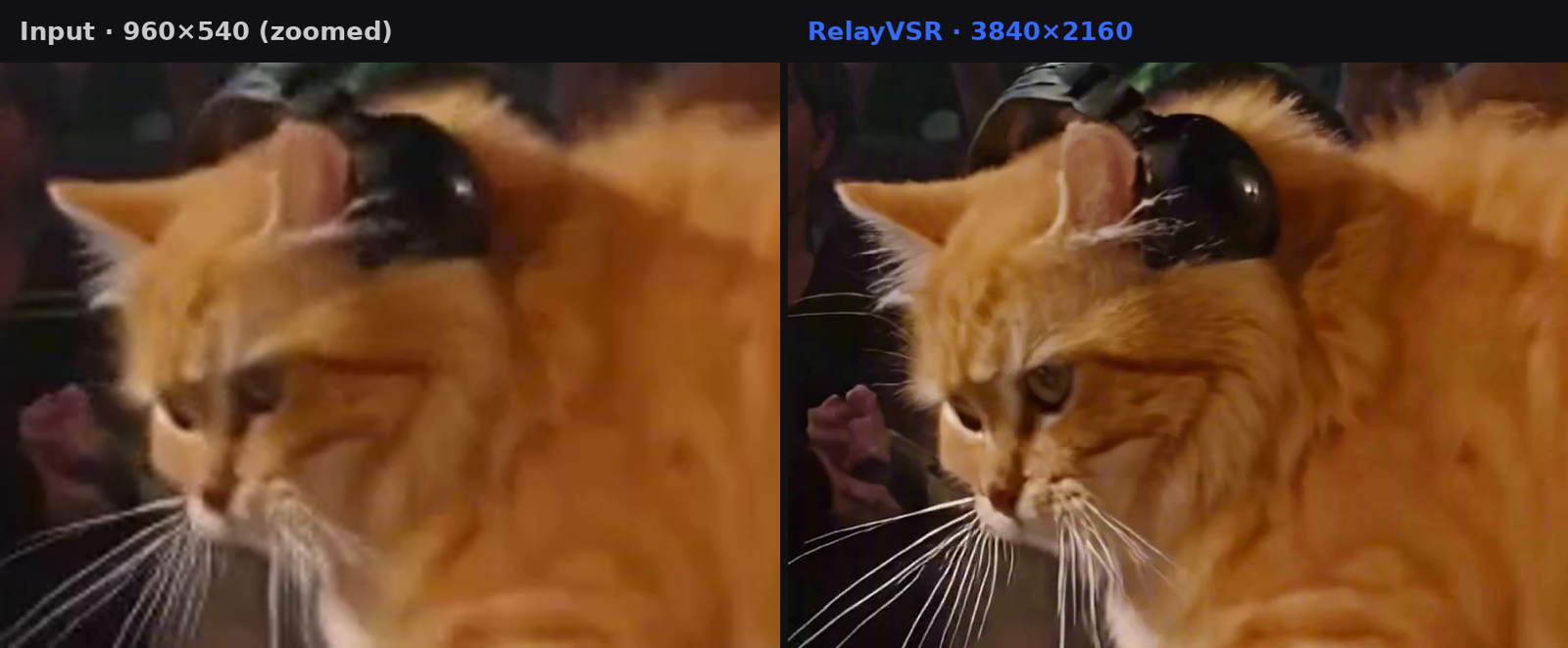
Same frame, same crop. Left: the 540p input, zoomed. Right: RelayVSR's 4K output. Whiskers, fur and the headphone edge come back sharp without the face changing.
The full upscaled clip (shown here at 1080p to keep the page light). The source clip was generated with LTX-2.5 in CNAPS Studio and downscaled to 540p before upscaling.
What it does
RelayVSR takes a short, low-resolution clip (up to 960×540) and returns it at exactly 4× the size — a 960×540 clip becomes 3840×2160 (4K).
The name comes from how it works. A large video generation model (adapted from Wan2.2-TI2V-5B) restores only a few keyframes, and a small, fast video network then "relays" that quality to every frame in between, using the low-resolution video to keep motion and content correct. The result is close to the source rather than redrawn.
In CNAPS Studio's video upscaling lineup, upscalers are marked Precision or Creative. Precision models like RelayVSR keep to the original. Creative models like FlashVSR+ Turbo draw in extra texture for the sharpest look, which can add details that weren't there.
Problem it solves
Use case | How RelayVSR helps |
Product and brand footage | Logos, packaging text and labels stay readable and unchanged |
People on camera | Faces are sharpened without turning into a different face |
Archive and UGC clips | Bring 540p footage up to 4K for reuse in new edits |
Before/after demos | Output matches the source closely, so comparisons are fair |
Input/Output
Input
- Video (required) — up to 960×540 in either orientation (landscape or portrait), 1–241 frames (about 10 s at 24 fps)
A larger clip such as 1280×720 or 1920×1080 is rejected before it is queued (VIDEO_RESOLUTION_EXCEEDS_LIMIT). Downscale or crop it first with Image Resize / Video Trim. In a Batch Run, one clip over the frame or resolution limit stops the whole node before it runs.
Parameters
Parameter | Details |
scale_factor | Fixed at 4× (read-only). 960×540 → 3840×2160 |
seed | -1 (default) picks a new random seed each run. Set a fixed number to reproduce an earlier result (advanced) |
Output
- Video — exactly 4× the input size, at most 3840×2160 (4K)
Speed
RelayVSR is slow and GPU-heavy: plan on about 7 minutes for a full-length (241-frame) clip. For a quick preview or a longer clip, use FlashVSR-v1.1 or SeedVR2 3B and save RelayVSR for the final pass.
Choosing a video upscaler
What you need | Use |
4K that matches the source (faces, text, logos) | RelayVSR (Precision) or Kandinsky 6 SR ×4 (Precision) |
A 1080p source taken to 4K, faithfully | Kandinsky 6 SR ×2 (Precision) |
The sharpest-looking 4K, extra texture is OK | FlashVSR+ Turbo (Creative) |
A fast upscale or a preview | FlashVSR-v1.1, SeedVR2 3B |
Highest-quality restoration of damaged footage | SeedVR2 7B |
Steer the look with your own upscaled keyframe | SparkVSR |
Technical Details
Approach | Large–small model collaboration: a large generative model restores sparse keyframe references, a lightweight Dual-Memory Video Transformer super-resolves every frame from those references plus the low-resolution video |
Large model | Adapted from Wan2.2-TI2V-5B |
Training | Video-Aware Reference Optimization (VARO) — reinforcement learning with a reward on final video quality and a reward on keyframe quality |
Scale | 4× (fixed) |
Paper efficiency figures | At 1080p on one A100 80GB, the authors report 29.29 FPS and 13.82 GB peak memory vs. 7.80 FPS and 24.4 GB for FlashVSR-Tiny (their setup, not CNAPS timings) |
Runtime | GPU, cloud — no local setup |
Developer | Xijun Wang, Xin Li, Zirui Lang, Suhang Yao, Haoran Li, Zhibo Chen — University of Science and Technology of China |
Compliance & Provenance
Provider | Open-source (USTC) |
Provider type | Specialized |
License | Apache 2.0 |
EU AI Act risk class | Minimal Risk |
Art. 50 transparency | Not applicable |
Region availability | Available globally |
Training data summary | Pending — provider has not yet published per Art. 53(d) |
For more on how we classify models and mark outputs, see our AI Policy.
Model Source
- Hugging Face: https://huggingface.co/kopper/RelayVSR
- GitHub: https://github.com/kopperx/RelayVSR
- Project page: https://kopperx.github.io/RelayVSR/
- Paper: arXiv:2609.37850
- License: Apache 2.0
How RelayVSR compares
Model | Profile | Scale | Max input | Notes |
RelayVSR | Precision | 4× | 960×540, 241 frames | ~7 min per full clip |
Kandinsky 6 SR ×4 | Precision | 4× | 960×540, 121 frames | Low flicker; ~13 min at max size |
Kandinsky 6 SR ×2 | Precision | 2× | 1920×1080, 121 frames | For 1080p sources |
FlashVSR+ Turbo | Creative | 4× | 960×540, 241 frames | Sharpest; may add texture; up to ~30 min |
FlashVSR-v1.1 | — | up to 4× | — | Fast streaming upscale |
SeedVR2 3B / 7B | — | up to 4× | — | Upscale + restoration |
SparkVSR | — | 2×, 3×, 4× | — | Optional reference keyframe |
Scope notes come from each node's own documentation; the models have not been benchmarked against each other inside CNAPS Studio.
All of these run inside CNAPS Studio — compare them side-by-side with the Video Compare tool.