Text-to-Image That Paints Pixels Directly — No VAE, Prompts Read as Sentences
Iris-3B is a 3-billion-parameter text-to-image model from SperidLabs that generates every pixel directly, with no VAE or latent space. Its prompt understanding comes from a frozen Qwen3-VL-4B language model, so it follows plain descriptive sentences rather than tag lists. Up to 1024×1024. Apache 2.0.
📸 See it in action
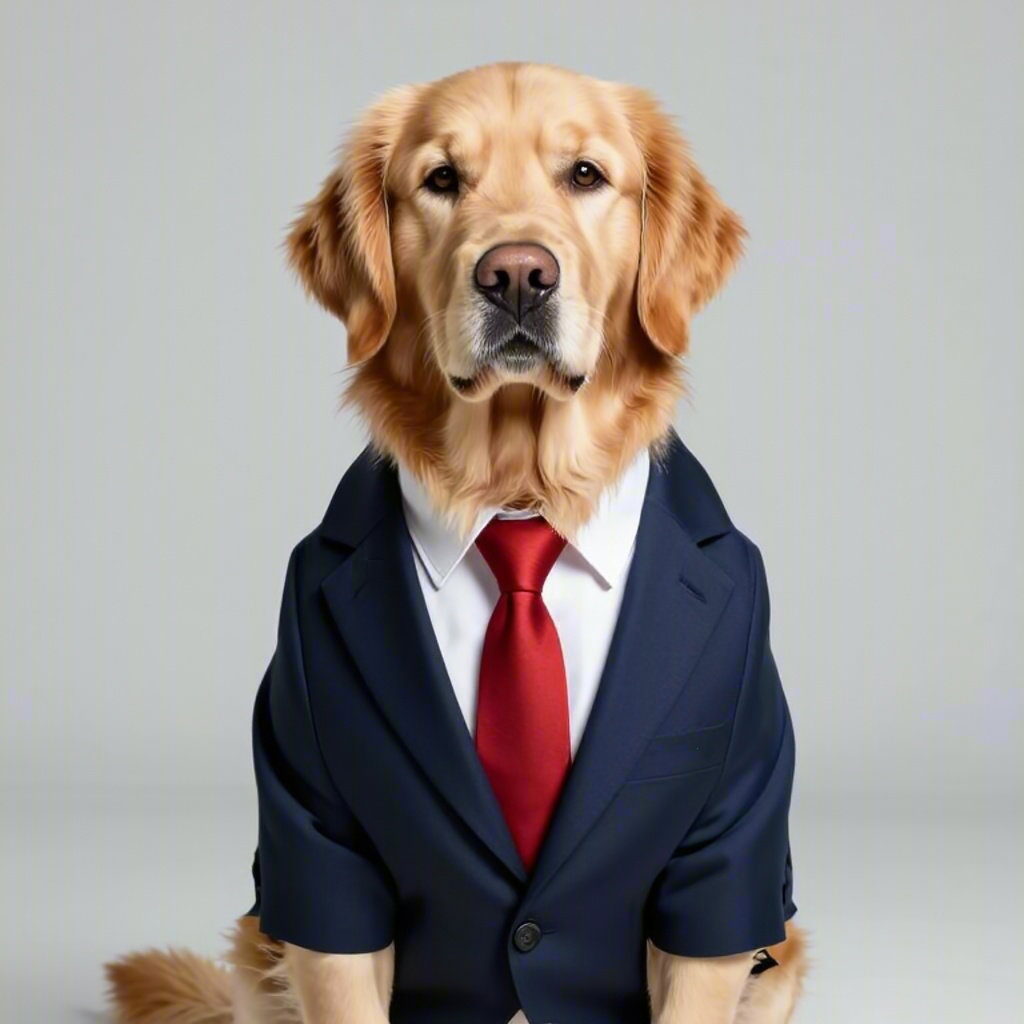
Our newest VP of Fetch. One descriptive sentence in, a 1024×1024 image out. Default settings (50 steps, guidance 3.0), seed 7, first try.
Prompt
A professional corporate headshot of a golden retriever wearing a navy suit, white shirt and a red tie, sitting upright and looking straight at the camera with a confident, serious expression, plain light grey studio backdrop, soft studio lighting, sharp focus, the kind of photo used for a LinkedIn profile
Written as a plain sentence, not a tag list — that's how Iris-3B reads prompts best. Yes, the suit has short sleeves; we're choosing to see it as a summer collection.
What it does
Iris-3B turns a text prompt into an image up to 1024×1024.
Most image generators draw in a compressed "latent" space and then decode it with a VAE. Iris-3B skips that step: its diffusion transformer outputs RGB pixels directly. Instead of a CLIP or T5 text encoder, it reads twelve hidden layers of a frozen Qwen3-VL-4B language model — which is why it handles natural, descriptive prompts well.
Write prompts as sentences: "A ceramic coffee mug on a wooden table by a rainy window, soft morning light" works better than "mug, table, window, rain, 4k". Prompts are cut off at 300 tokens.
Problem it solves
Use case | How it helps |
Natural-language prompts | Describe the scene in plain English; no prompt-tag tricks needed |
Prompts from an LLM node | Pairs well with a language model writing descriptive prompts upstream |
Reproducible images | Same prompt + seed + size + steps gives the same image |
Open license | Apache 2.0 weights |
Input/Output
Input
- Text prompt (required) — a plain descriptive sentence or paragraph. Truncated at 300 tokens
Parameters
Parameter | Details |
steps | 20–50, default 50. Sampling steps (DPM-Solver++). 50 is what the model was graded at; fewer steps trade quality for time roughly linearly |
seed | -1 (default) draws a new seed per run. Same seed + prompt + size + steps reproduces an image |
width | 512 / 768 / 1024 px. Larger sizes are refused — the model was trained up to 1024 px |
height | 512 / 768 / 1024 px |
guidance_scale | 1–8, default 3.0 (advanced). Higher follows the prompt more literally but can over-saturate. 1.0 turns guidance off and halves the time |
negative_prompt | Empty by default (advanced). What to steer away from. Only works while guidance_scale is above 1.0 |
Output
- Image — 512–1024 px per side (about one megapixel at most). Chain an image upscaler such as PiSA-SR for print sizes
Accuracy
Provider-reported at 1024×1024:
Benchmark | Iris-3B |
GenEval | 0.798 |
DPG-Bench | 86.52 |
LongText-Bench (EN) | 0.857 |
OneIG-Bench (EN) | 0.540 |
Known limits (from the model card): text inside images and exact object counts aren't always reliable, and output is about one megapixel.
Technical Details
Architecture | Pixel-space diffusion transformer — 8 dual-stream + 16 single-stream blocks and a 4-block pixel head. No VAE |
Parameters | ~3B (plus a frozen 4B text encoder) |
Text encoder | Qwen3-VL-4B-Instruct, frozen — conditioned on twelve hidden layers |
Training | Rectified flow, from scratch at 256 → 512 → 1024 px, then fine-tuning at 1024 px |
Sampler | DPM-Solver++ |
Max resolution | 1024×1024 |
Runtime | GPU, cloud — no local setup |
Developer | SperidLabs |
Compliance & Provenance
Provider | SperidLabs (open weights) |
Provider type | Specialized |
License | Apache 2.0 (text encoder Qwen3-VL-4B: Apache 2.0) |
EU AI Act risk class | Limited Risk |
Art. 50 transparency | Required — outputs are marked. See AI Policy §2. |
Region availability | Available globally |
Training data summary | Pending — provider has not yet published per Art. 53(d) |
For more on how we classify models and mark outputs, see our AI Policy.
Model Source
- Hugging Face: https://huggingface.co/speridlabs/iris-3b
- GitHub: https://github.com/speridlabs/iris-3b
- Paper: arXiv:2610.09450
- License: Apache 2.0
How Iris-3B compares
Model | Best for | Notes |
Z-Image-Turbo | Photorealistic images; English and Chinese text inside the image | Distilled, bilingual prompts |
FLUX.2 Klein 4B | Fast generation plus multi-reference editing | 4B, as few as 4 steps |
FLUX Schnell | Fast general-purpose text-to-image | 12B, 1–4 steps |
SANA-Sprint 1.6B | Quick drafts and high-volume generation | 1–4 steps |
Iris-3B | Descriptive sentence prompts; pixel-space output | 3B, no VAE, up to 1024 px |
OmniGen2 | Generate, edit and combine reference images | ~15–30 s per image |
GLM-Image | Images where long or exact text must be spelled right | Hybrid autoregressive + diffusion |
DeepGen-1.0 | Reasoning-heavy prompts; generation and editing | Lightweight unified model |
Rough guidance: Z-Image-Turbo for photoreal, SANA-Sprint or FLUX Schnell for speed, GLM-Image for text in the image. Try Iris-3B when your prompts are long natural descriptions. Scope notes come from each node's own documentation; the models have not been benchmarked against each other inside CNAPS Studio.
All of these run inside CNAPS Studio — compare them side-by-side.