
The Sharpest-Looking 4K Video — One-Step Diffusion Upscaling
FlashVSR+ Turbo upscales a video exactly 4×, up to 3840×2160, in a single diffusion step. It is a Creative upscaler: it synthesizes fine detail for the crispest result, so textures that weren't in the source can appear. From Shanghai AI Lab, CUHK and Tsinghua — the successor to FlashVSR. Apache 2.0.
📹 See it in action
Too cool for 540p. A tortoise in sunglasses making its slow-motion entrance, filmed at 960×540 and upscaled ×4 to 3840×2160. Default settings.
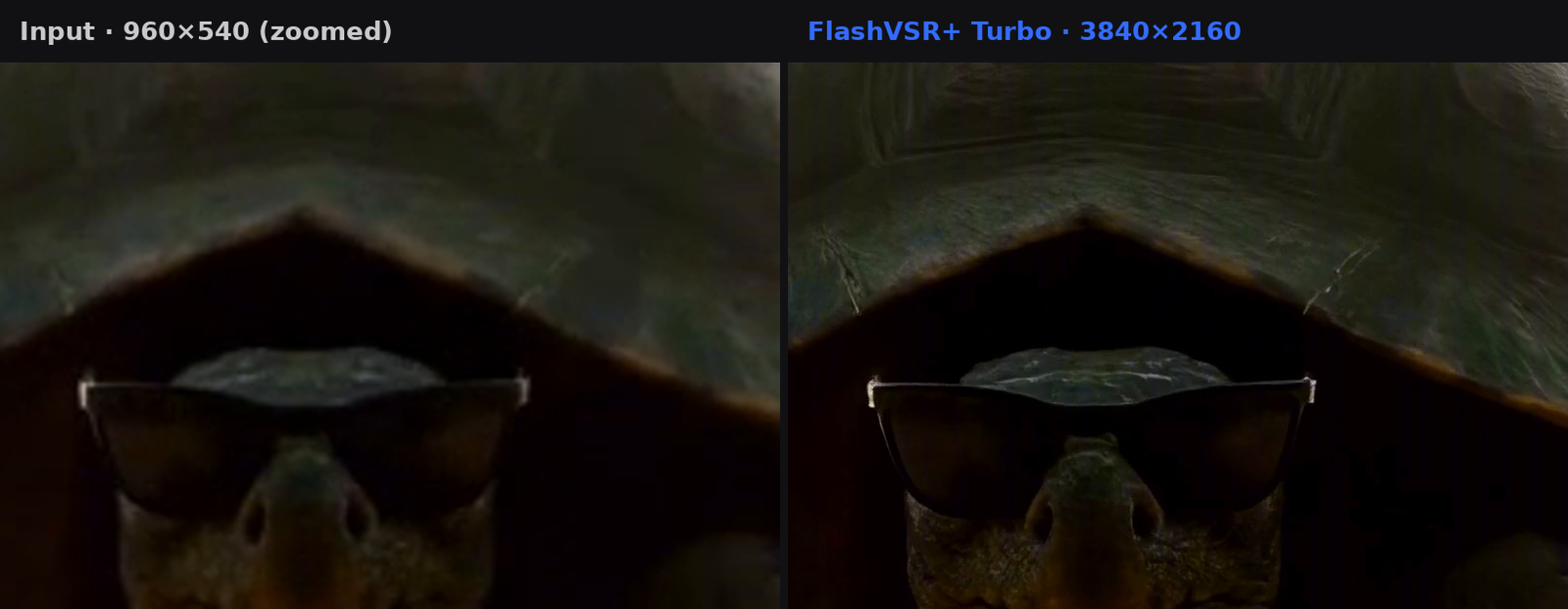
Same frame, same crop. Left: the 540p input, zoomed. Right: FlashVSR+ Turbo. Shell ridges, skin texture and the sunglasses' edges are filled in. This is the Creative tier: some of that texture is invented detail that looks right, not recovered detail. For footage that must stay faithful, use a Precision model like RelayVSR.
The full upscaled clip (shown here at 1080p to keep the page light). The source clip was generated with LTX-2.5 in CNAPS Studio and downscaled to 540p before upscaling.
What it does
FlashVSR+ Turbo takes a clip up to 960×540 and returns it at exactly 4× — 960×540 becomes 3840×2160 (4K). It is the Turbo preset of FlashVSR+, the follow-up to FlashVSR-v1.1 that is already in CNAPS Studio.
It is tuned for perceived sharpness. Where the source is soft, it draws in plausible texture — hair, fabric, foliage, skin pores. That looks great on scenery and B-roll, but it means the result may not match the original exactly. When faces, on-screen text or logos have to stay true, use a Precision upscaler (RelayVSR or Kandinsky 6 SR) instead.
Problem it solves
Use case | How FlashVSR+ Turbo helps |
Hero shots and B-roll | Maximum crispness for landscapes, textures and atmosphere |
AI-generated video | Adds the fine detail low-res generators leave out |
Social and display at 4K | Strong first impression on large screens |
Creative remasters | When "looks better" matters more than "matches exactly" |
Input/Output
Input
- Video (required) — up to 960×540 in either orientation, 21–241 frames (about 1–10 s at 24 fps)
A larger clip such as 1280×720 or 1920×1080 is rejected before it is queued (VIDEO_RESOLUTION_EXCEEDS_LIMIT) — downscale or crop it first. Clips under 21 or over 241 frames are rejected too (VIDEO_FRAMES_BELOW_LIMIT / VIDEO_FRAMES_EXCEEDS_LIMIT). In a Batch Run, one clip outside these limits stops the whole node before it runs.
Parameters
Parameter | Details |
scale_factor | Fixed at 4× (read-only). 960×540 → 3840×2160 |
seed | -1 (default) picks a new random seed each run. Set a fixed number to reproduce an earlier result (advanced) |
Output
- Video — exactly 4× the input size, at most 3840×2160 (4K)
Speed
Slow and GPU-heavy in this 4K setting: up to about 30 minutes for a full-length (241-frame) clip. Use it when you specifically want 4K at maximum sharpness and can wait. For a quick upscale, a preview or a longer clip, use FlashVSR-v1.1 or SeedVR2 3B.
Choosing a video upscaler
What you need | Use |
The sharpest-looking 4K, extra texture is OK | FlashVSR+ Turbo (Creative) |
4K that matches the source (faces, text, logos) | RelayVSR or Kandinsky 6 SR ×4 (Precision) |
A 1080p source taken to 4K | Kandinsky 6 SR ×2 (Precision) |
A fast upscale or a preview | FlashVSR-v1.1, SeedVR2 3B |
Technical Details
Approach | One-step diffusion video super-resolution (successor to FlashVSR) |
What's new in FlashVSR+ | Hybrid Attention — uses spatial and temporal locality while keeping sparse global interactions. Reward-Yield Distribution Matching Distillation (RY-DMD) — aligns output to preference rewards without differentiating through the reward model |
Efficiency (authors) | Up to 2× DiT speed-up and 45% lower peak memory vs. FlashVSR; untiled 4K inference on a single 24 GB RTX 4090 |
Preset | Turbo (the repo also ships Base and V1 presets) |
Scale | 4× (fixed) |
Runtime | GPU, cloud — no local setup |
Developer | Ruchang Yao, Shi Guo, Junhao Zhuang, Mingde Yao, Xin Cai, Jiahao Zhan, Bin Fu, Xinyuan Chen, Yu Qiao, Tianfan Xue — Shanghai AI Lab, MMLab CUHK, Tsinghua University, CPII |
Compliance & Provenance
Provider | Open-source (OpenImagingLab) |
Provider type | Specialized |
License | Apache 2.0 |
EU AI Act risk class | Minimal Risk |
Art. 50 transparency | Not applicable |
Region availability | Available globally |
Training data summary | Pending — provider has not yet published per Art. 53(d) |
For more on how we classify models and mark outputs, see our AI Policy.
Model Source
- GitHub: https://github.com/OpenImagingLab/FlashVSR_Plus
- Weights (Turbo / Base): https://huggingface.co/ruchangyao/FlashVSR_plus
- Paper: arXiv:2610.17552
- License: Apache 2.0
How FlashVSR+ Turbo compares
Model | Profile | Scale | Max input | Notes |
FlashVSR+ Turbo | Creative | 4× | 960×540, 241 frames | Sharpest; may add texture; up to ~30 min |
FlashVSR-v1.1 | — | up to 4× | — | Predecessor; fast streaming upscale |
RelayVSR | Precision | 4× | 960×540, 241 frames | Faithful; ~7 min per full clip |
Kandinsky 6 SR ×4 | Precision | 4× | 960×540, 121 frames | Faithful, low flicker |
Kandinsky 6 SR ×2 | Precision | 2× | 1920×1080, 121 frames | For 1080p sources |
SeedVR2 3B / 7B | — | up to 4× | — | Upscale + restoration |
Scope notes come from each node's own documentation; the models have not been benchmarked against each other inside CNAPS Studio.
All of these run inside CNAPS Studio — compare them side-by-side with the Video Compare tool.